CPR Training Everett WA
When business owners ask about CPR training, the question often sounds like this:
“Is this required by OSHA?”
The honest answer?
It depends.
OSHA (the Occupational Safety and Health Administration) does not require every business to provide CPR training. However, OSHA does require employers to ensure employees have access to prompt medical care in the event of an emergency.
Understanding what that means is critical for responsible workplace preparedness.
Let’s clarify what OSHA actually expects.
OSHA’s General Duty Clause
OSHA’s General Duty Clause requires employers to provide:
“A workplace free from recognized hazards that are causing or are likely to cause death or serious physical harm.”
Source:
OSHA General Duty Clause
Duties | Occupational Safety and Health Administration
While this doesn’t specifically mandate CPR training, it establishes the foundation of employer responsibility for safety.
OSHA Standard: Medical Services and First Aid (29 CFR 1910.151)
This is the regulation most relevant to CPR and emergency preparedness.
It states:
“In the absence of an infirmary, clinic, or hospital in near proximity to the workplace… a person or persons shall be adequately trained to render first aid.”
Full standard:
29 CFR 1910.151 – Medical Services and First Aid
1910.151 – Medical services and first aid. | Occupational Safety and Health Administration
The key phrase is “near proximity.”
If emergency medical services cannot reach the workplace within a reasonable timeframe, OSHA expects employers to have trained personnel on site.
In many environments—including construction, manufacturing, warehouses, and certain public-facing businesses—this can make CPR and First Aid training a practical necessity.
Construction-Specific Requirements (29 CFR 1926.50)
For construction environments, OSHA is more explicit.
Standard 29 CFR 1926.50 states that:
- Employers must ensure medical personnel are reasonably accessible
- If not, at least one person must be adequately trained in first aid
Source:
29 CFR 1926.50 – Medical Services and First Aid (Construction)
1926.50 – Medical services and first aid. | Occupational Safety and Health Administration
Because construction sites often lack immediate medical access, CPR and AED training are commonly recommended best practices.
What OSHA Does Not Explicitly Require
OSHA does not universally mandate:
- That every employee be CPR certified
- That every workplace have an AED
- That all industries follow identical emergency protocols
However, OSHA may cite employers if:
- There is no plan for medical emergencies
- No trained personnel are available
- Emergency response access is unreasonably delayed
Compliance is about preparedness—not paperwork.
Beyond Compliance: What Smart Employers Do
Forward-thinking employers don’t ask, “What’s the bare minimum?”
They ask:
- How quickly could help realistically arrive?
- Do we have trained staff on every shift?
- Would employees feel confident responding?
This is why many businesses in Everett and Snohomish County choose CPR training in Everett, WA even when it’s not explicitly mandated.
Preparedness reduces liability.
It protects employees.
It strengthens company culture.
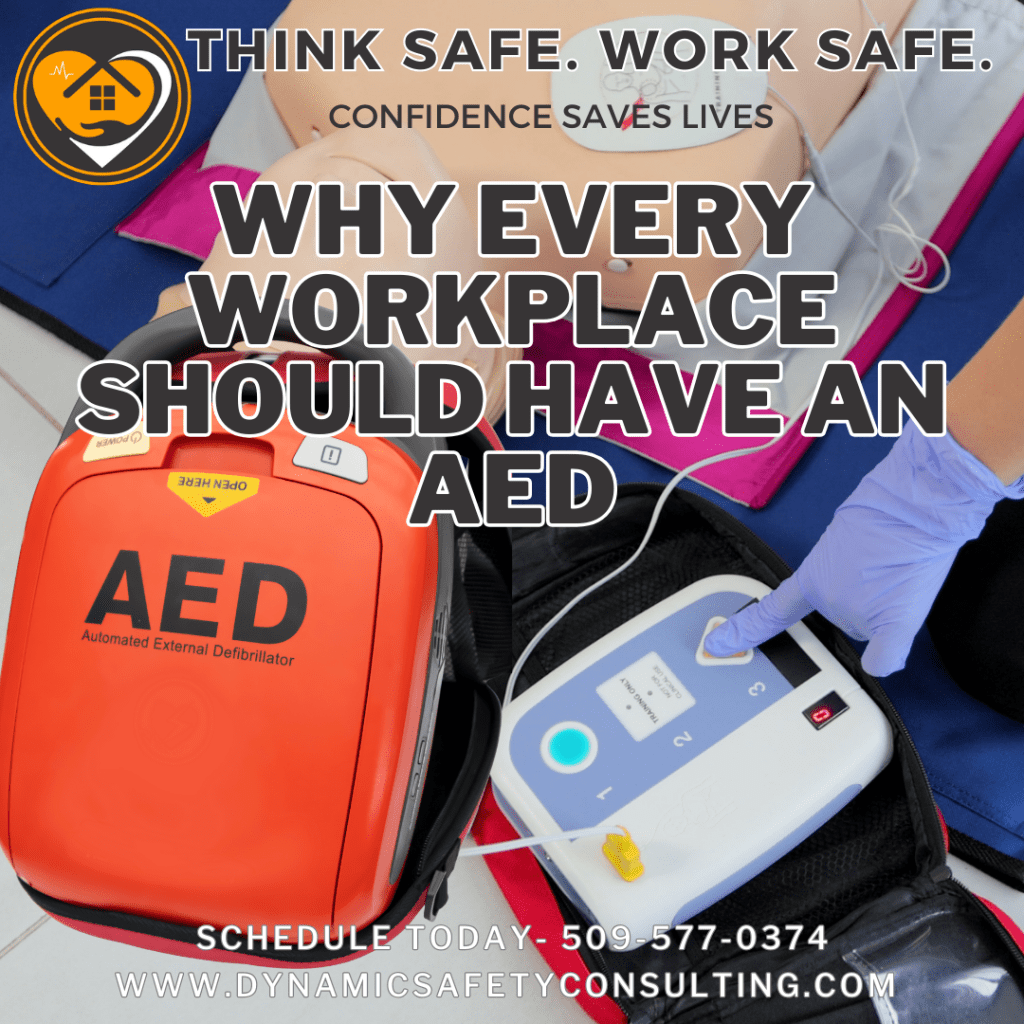
The Role of AEDs
While OSHA does not universally require AEDs, they are widely recognized as best practice in:
- Large facilities
- Public-facing businesses
- Industrial settings
- Schools and fitness environments
AEDs are addressed in OSHA’s guidance documents and are supported by the American Heart Association and other safety organizations as critical early-response tools.
OSHA AED Guidance:
Automated External Defibrillators (AEDs) – Overview | Occupational Safety and Health Administration
The Bottom Line
OSHA expects employers to:
- Ensure prompt medical care
- Provide trained personnel when needed
- Maintain a safe work environment
CPR and First Aid training often fulfill that expectation—especially in environments where emergency response may not be immediate.
For businesses considering workplace CPR training in Everett, WA, the real question isn’t simply “Is it required?”
It’s:
“Are we prepared?”
Prepared workplaces don’t rely on assumptions.
They build systems that support real response.
Want to Strengthen Your Emergency Plan?
If you’re unsure whether your workplace meets OSHA expectations—or whether CPR training is appropriate for your environment—hands-on CPR training in Everett, WA can help you build a practical, compliant emergency response plan.
Preparedness isn’t about fear.
It’s about responsibility.

 Dynamic Safety Consulting
Leave a comment